Physical Address
304 North Cardinal St.
Dorchester Center, MA 02124
Physical Address
304 North Cardinal St.
Dorchester Center, MA 02124
TME Chart unveiled its 30 UNDER 30 list on May 6, naming Lars Huang, Yu Zi, and Zhicheng Mu as top picks across three age-based groups.
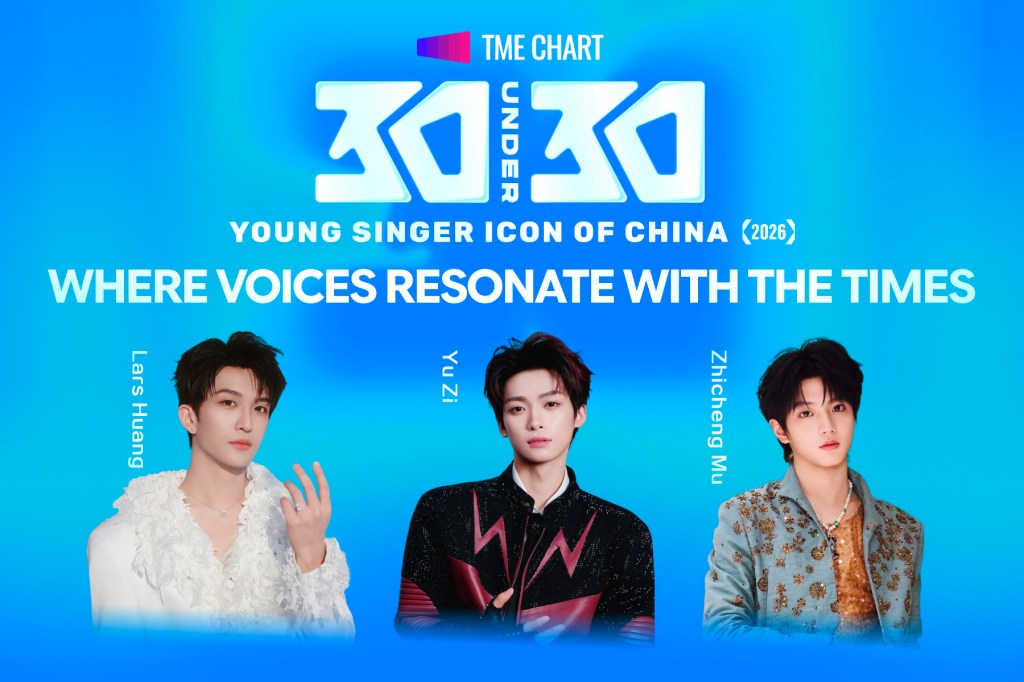
On Wednesday (May 6), TME Chart released the full roster for its 30 UNDER 30 “Top 30 Young Singers” list, and the headlines are blunt and specific: Lars Huang, Yu Zi and Zhicheng Mu finished No. 1 in the Core Group, Pioneer Group and Rising Star Group, respectively. The announcement doubles as a snapshot of how the Chinese music industry is trying to quantify youth and potential in one tidy framework.
TME says the selection leaned on annual performance data pulled from two of its internal charts — the TME Uni Chart and the TME Wave Chart — and then blended those metrics with public voting within the defined categories. That combination of objective numbers and fan input was central to this year’s upgraded recognition system, a change the platform framed as a way to better reflect both commercial traction and listener preference.
The honorees are grouped by birth year into three tiers: the Core Group (born 1996–1999), the Pioneer Group (born 2000–2005), and the Rising Star Group (born after 2006). By design, that tiered structure maps artists onto different stages of early career development and gives a demographic shape to what might otherwise be a scattershot list of breakout names.
Since its launch, TME Chart’s “30 UNDER 30” has been presented as a kind of industry benchmark for emerging talent. The initiative is described as operating under the principles of professionalism, fairness, and diversity, and it explicitly aims to encourage young musicians to maintain creative focus, push artistic boundaries, and express youth through innovation — all while generating “positive impact through high-quality music,” according to the program notes.
That language reads like a mission statement, and the mechanics of the list underline the attempt to balance measurable success with public sentiment. Recognizing a No. 1 in each age bracket makes the exercise less about a single breakout star and more about tracing trajectories: who is leading their cohort now, and who might carry that momentum forward.
For Lars Huang, Yu Zi and Zhicheng Mu, topping their respective groups is a definable marker in a moment when platforms and playlists heavily shape careers. For the industry, the list functions as both a promotional calendar entry and a curated dataset that signals which young singers are being watched and by what measures.
Whether the 30 UNDER 30 becomes a sustained predictor of long-term success will depend on how the charts, the public and the artists themselves respond to that spotlight in the months and years ahead. For now, the May 6 announcement is less a final judgment than a temperature check: a formalized attempt to identify the faces and names that the Chinese market and its listeners currently consider most noteworthy among their generation.