Physical Address
304 North Cardinal St.
Dorchester Center, MA 02124
Physical Address
304 North Cardinal St.
Dorchester Center, MA 02124
Aaron Bay-Schuck honored Mo Ostin’s advice as Warner Records was celebrated at the 2026 Grammy Hall of Fame Gala in Beverly Hills.
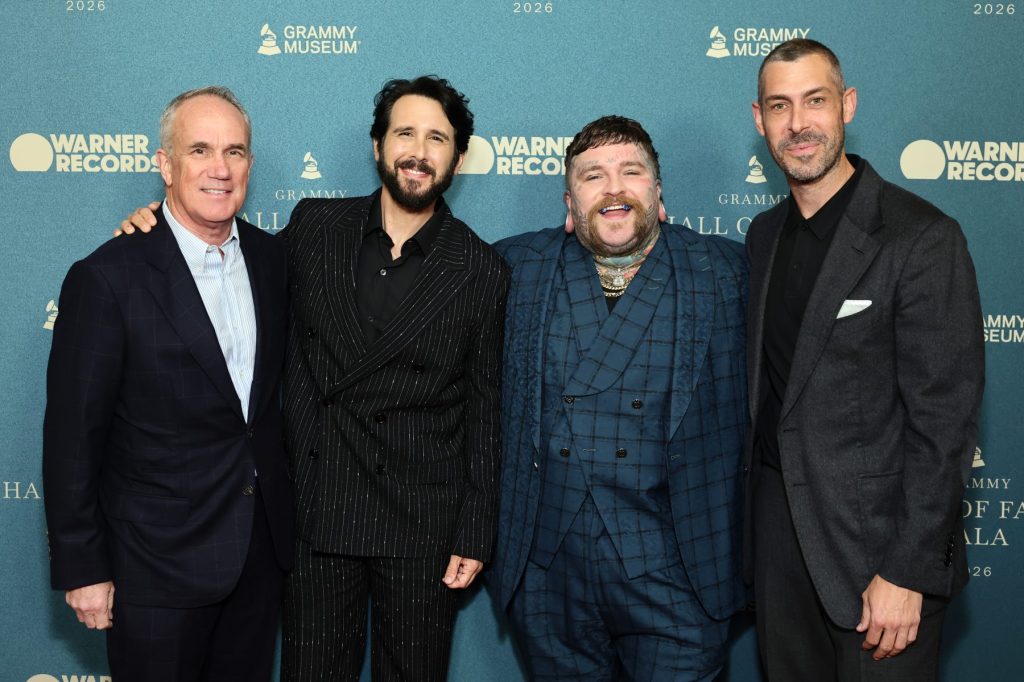
Warner Records took center stage at the 2026 Grammy Hall of Fame Gala on Friday night, May 8, at the Beverly Hilton in Beverly Hills, with co-chairman and CEO Aaron Bay-Schuck using the label tribute to look backward even as he framed Warner’s present-day identity. The night also gave Warner artists Teddy Swims and Josh Groban two songs each in a salute that folded performance into institutional history.
Bay-Schuck’s remarks turned on a lunch he shared with the late Warner legend Mo Ostin before taking the job. Recalling that conversation, Bay-Schuck said he had hoped for a kind of shortcut to understanding how Ostin kept Warner “the most exciting label in the world decade after decade.” Instead, he said, Ostin offered something less flashy and more difficult to manufacture: create an environment where artists feel “supported and protected,” give them room to “experiment, to succeed and to fail,” and build a culture where people feel “inspired, collaborative and proud to represent.”
“So, to receive this honor tonight feels like confirmation that we have indeed done that,” Bay-Schuck said. “And I can’t tell you how proud and gratifying that is for me and our Warner family.”
It was the third year in a row the Grammy Hall of Fame event has included a label tribute, following previous honors for Atlantic Records and Republic Records. In Warner’s case, the ceremony also doubled as a reminder that label identity still matters in an era when the business often seems to flatten itself into metrics. Bay-Schuck made that point plainly, arguing that when he and Tom Corson took over Warner Records in 2018, they knew the company had to be repositioned for the future, but not before acknowledging the past.
He pointed to the label’s lineage, naming Prince, Madonna, Jimi Hendrix, Fleetwood Mac, Tom Petty, the Red Hot Chili Peppers and Neil Young among the artists who helped define it. Those names were not just a roll call of prestige. In Bay-Schuck’s telling, they represented a model of artistic fearlessness that still carries weight. “These superstars were fearless, unapologetically themselves,” he said. “They took risks. They dared to be different, and they stood for something.”
He then drew a line from that history to Warner’s current strategy, saying that in a landscape shaped by data and algorithms and the chase for “quick wins and fleeting moments,” the label chose to keep emphasizing “talent, quality and vision.” He also argued for patience over convenience, saying Warner wanted to show that waiting for greatness, rather than settling for good, remained the smarter move, and that artist development should still be a central obligation for a major label.
Corson, who spoke before Bay-Schuck, echoed that emphasis on continuity. He thanked the broader Warner organization, including Warner Records Nashville, Warner UK and the wider Warner Music Group, as well as the generations of executives, creatives and artists who built the label before them. “We’re standing on the shoulders of giants tonight,” he said. “We truly appreciate it. Most importantly, thank you to our artists. Everything begins and ends with them, and we’re especially proud to have two extraordinary representatives of our label here tonight.”
Corson also made clear that his own path to Warner carried a sense of destination. Before joining the company, he had worked at IRS Records, A&M, Capitol, Columbia, J Records, Arista and the RCA Music Group. “I always wanted to work at the label,” he said. “It took me a long time to get hired there, and I’m glad I did. It’s been amazing. But it’s a team sport, right? And to all our team over there, give yourselves a hand.”
The performances gave the tribute its emotional shape. Swims sang “Mister Know It All” and his Billboard Hot 100-topping breakthrough “Lose Control,” while Groban delivered two songs from Cinematic, which arrived the same day: “Brucia La Terra,” a Sicilian-language version of “Love Theme From The Godfather” sometimes known as “Speak Softly, Love,” and “Stand by Me,” the latter with Take 6 joining him for the event’s close.
Groban also thanked the label for believing in him early, saying Warner took a chance on “a shy kid with a big voice” when other labels did not quite know what to do with him. It was a fitting note for a night built around legacy, but also around the harder, less ceremonial work of keeping a major label’s identity intact.