Physical Address
304 North Cardinal St.
Dorchester Center, MA 02124
Physical Address
304 North Cardinal St.
Dorchester Center, MA 02124
Eric Church gave UNC-Chapel Hill’s class of 2026 a guitar-centered commencement speech and closed with a performance of “Carolina.”
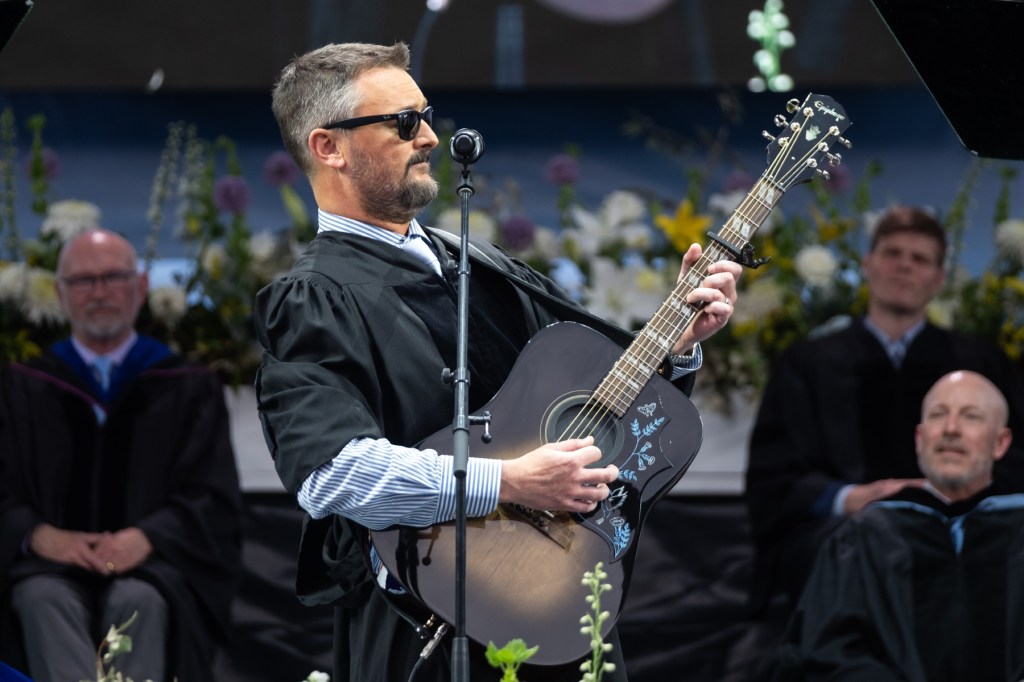
Eric Church brought his own logic to UNC-Chapel Hill’s commencement ceremony on Saturday, May 10, turning a keynote address for the class of 2026 into something closer to an extended guitar lesson. With sunglasses on and his instrument in hand, the country star stood before more than 7,000 graduates at Kenan Stadium in Chapel Hill, N.C., and made the speech feel less like a formal obligation than an attempt to explain a life by way of tuning strings.
That approach did not come easily. Church said he had “torn up multiple speeches” and “thrown things” before landing on the idea that finally made sense to him. “And in one of my fits of frustration, I sat down with a guitar. And I thought, man, who am I kidding. I need to figure out a way to do this with a guitar,” he told the crowd. For the Granite Falls, N.C., native, the choice fit the setting as much as it fit his own career identity: a singer-songwriter who has twice topped the Billboard 200 and scored three No. 1s and two No. 2s on Top Country Albums.
Church opened by talking about an out-of-tune guitar string, describing it as “something that almost gets there, it tries, but doesn’t,” and as “the sound of something beautiful that has not been tended to.” From there, he stretched the metaphor across the rest of the speech, using six strings to stand in for faith, family, heart, ambition and resilience, community, and a sense of self. His point was not subtle, but it was effective in the way graduation speeches rarely are: as a reminder that a life can come apart by degrees, and that maintenance matters as much as momentum.
For Church, the message to UNC’s graduating class, which included 4,453 undergraduates, 1,608 master’s students and 981 doctoral degree students, 5,594 of them North Carolina residents, was rooted in ambition without drifting into abstraction. “I want you to want things. You should want things,” he said. “The world has more than enough people standing at the edge of their own potential waiting for a permission slip that was never gonna arrive. Want the thing. Say it out loud. Build toward it with everything you have.”
But he was equally intent on pushing back against the more hollow forms of contemporary success. “Your generation faces a temptation no generation before has ever faced,” he said. “The temptation to perform to everyone and belong to no one. To be globally visible and locally invisible. To have thousands of followers and no one knows actually where you live. Resist it. Plant yourself somewhere.” He urged the students to learn “the actual names, not usernames, of the people around you,” to volunteer, coach, and help build what their communities need even if the internet never notices.
In one of the speech’s clearest pivots, Church framed originality as a responsibility rather than a brand exercise. “The world does not need another cover song. It needs an original,” he said. That idea ran through the rest of his remarks, where the six strings became “six principles” and “six pillars” that all drift over time. Faith goes quiet, family gets complicated, ambition hollows out, resilience wears thin. None of that, he said, should be mistaken for failure. It is simply life in an imperfect world.
“The difference between a life that sounds like music and a life that sounds like noise is whether you stop and listen,” Church said, insisting on honesty over volume, adjustment over denial. “Because you will notice. The part of you that knows what the chord should sound like will always notice. It will not let you go. Life won’t be right until it is tuned. Trust what your heart hears and is telling you about your song.”
No UNC-Chapel Hill appearance by Church would have been complete without “Carolina,” the title track from his second studio album, released in 2009. He closed by performing the song on guitar as rows of new graduates put their arms around one another and swayed, a familiar bit of regional nostalgia filtered through a ceremony that had already been shaped by his own plainspoken, slightly sideways sense of meaning.