Physical Address
304 North Cardinal St.
Dorchester Center, MA 02124
Physical Address
304 North Cardinal St.
Dorchester Center, MA 02124
John Waters defended Eminem against homophobia claims, citing the rapper’s explicit wedding gift to Elton John and David Furnish.
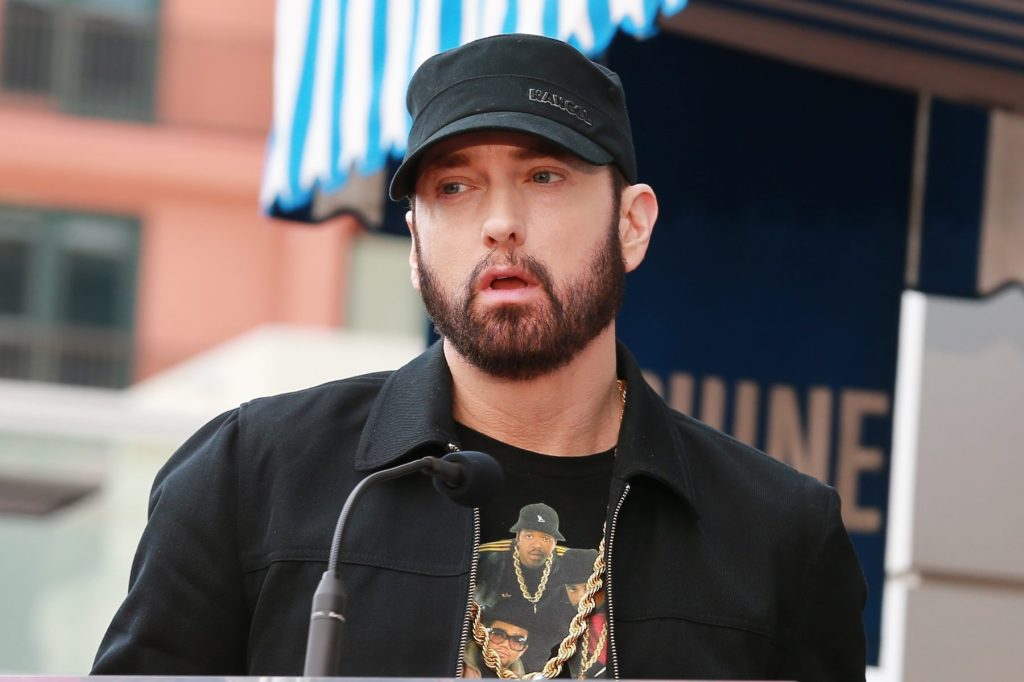
Eminem has spent much of his career answering for lyrics that have pushed past what even rap’s long tolerance for provocation can comfortably hold. John Waters, though, is not interested in flattening him into a single accusation.
On Wednesday, May 13, Waters appeared on the Las Culturistas podcast with Matt Rogers and Bowen Yang and brought up one of the stranger, more telling details in Eminem’s long relationship with Elton John and David Furnish: the wedding gift he chose for the couple. Waters, who has openly spoken about his sexuality, framed the gesture as evidence against the familiar charge that the Detroit rapper is simply homophobic.
“He’s not homophobic,” Waters said of Em. “He gave Elton John and David Furnish matching gold c–k rings for their wedding.”
It is, on its face, exactly the sort of gift that belongs to Eminem’s mythology. The image of Elton and Furnish opening it after their December 2014 wedding is hard to miss, and Elton himself has already made clear the present was not lost on him. Speaking to The Guardian in 2019, he described the rings as sitting “there, like the crown jewels,” in a box on satin cushions, adding, “They’re wonderful to look at. … They’re kind of sacrosanct. The fact they came from Eminem makes it even better.”
That relationship stretches back further than the gift. Eminem and Elton John first performed together on “Stan” at the 2001 Grammy Awards, a collaboration that became one of the more discussed moments in either artist’s public history. Eminem later told MTV in 2004 that when he met John, he did not know he was gay. What mattered, he said, was the support John gave him anyway. “I didn’t know anything about his personal life. I didn’t really care,” Eminem said. “But being that he was gay and he had my back, I think it made a statement in itself saying that he understood where I was coming from.”
That distinction between Marshall Mathers and Slim Shady has long been central to how Eminem has defended his work. In 2013, after criticism surrounding “Rap God,” he told Rolling Stone that the people paying attention should already know the difference between his beliefs and the character he deploys in songs. “Well, look, I’ve been doing this s–t for, what, 14 years now? And I think people know my personal stance on things and the personas that I create in my music,” he said. “And if someone doesn’t understand that by now, I don’t think there’s anything I can do to change their mind about it.”
But the separation has not always held up as neatly in the public imagination, especially after 2018’s Kamikaze. On “The Fall,” Eminem used a homophobic slur in a diss aimed at Tyler, The Creator, then later acknowledged that he had crossed a line. In an interview on Sway’s YouTube channel, he said, “I think the word that I called him on that song was one of the things where I felt like, ‘This might be too far.’” He added, “Because in my quest to hurt him, I realized that I was hurting a lot of other people by saying it. It was one of the things that I kept going back to and going, ‘I don’t feel right with this.’”
Waters’ comments do not erase that history, but they do complicate the easy version of Eminem that gets repeated whenever his name comes up in conversations about offensive language. The story, as ever, is messier than the label.