Physical Address
304 North Cardinal St.
Dorchester Center, MA 02124
Physical Address
304 North Cardinal St.
Dorchester Center, MA 02124
Carter Faith's Cherry Valley earned an ACM album of the year nod, setting up her first Vegas awards-show performance and a deluxe reissue.
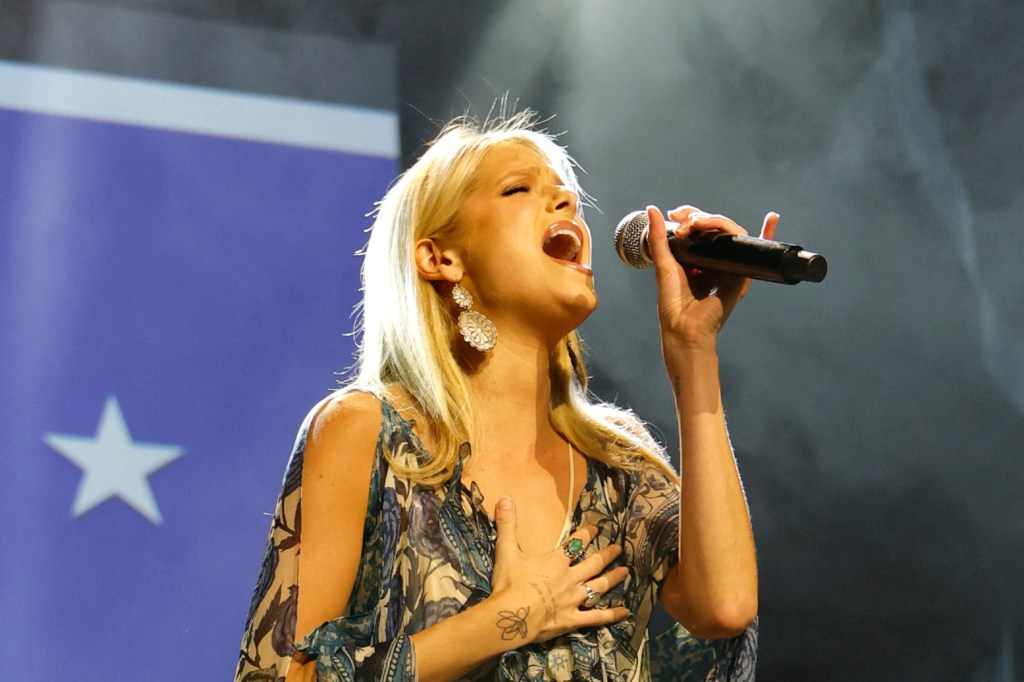
When Amazon asked Carter Faith to cut Faith Hill’s “Let’s Go to Vegas” for the Academy of Country Music Awards’ return to Nevada, she pushed back a flight to Europe and made room for the assignment. It was the kind of request that could have felt like a side job, but for Faith it landed differently. Her given name has always invited the Faith Hill comparison, and as she puts it, that made the whole thing feel a little personal.
“When you’re younger, you feel connected to people for random things, and that was one of the things for me,” Faith says. “They asked me to sing that song. I was like, ‘Hell, yeah, I’ll cut it.’”
What she did not expect, at least not then, was that the bigger story would be her own. Faith had already been told she was not eligible for the ACM’s new female artist trophy, since the academy’s rules require, among other things, a top 50 single and she had not yet sent a song to radio. So when she learned, while overseas, that Cherry Valley had been named a finalist for album of the year at the May 17 ceremony, the moment registered as more than a consolation prize. It was the kind of nomination that says something about how the industry is choosing to listen.
“I don’t have a hit on there, I don’t have a radio song, I don’t play these arenas,” she says. “But I feel like people just really connected with the music because it was different and said something that maybe a lot of people haven’t said in a while. Or ever.”
That connection is the quiet engine behind Cherry Valley, an album titled after a small community about 40 miles east of Nashville’s Music Row. Faith spotted the name on a road sign and imagined a place with a bright exterior and darker truths running underneath it. The record moves through sex, drugs, religion, hypocrisy and alcohol, often with a wink, but never casually. Its opening title track arrives with strings and a cinematic sweep, and the 15-song project keeps shifting among folk, honky-tonk and traditional pop, even as the whole thing feels stitched together with a single aesthetic thread.
The album’s range might sound unruly on paper, but producer Tofer Brown says the references were chosen with surprising discipline. He and Faith were listening to older records and kept circling back to a very specific stretch of pop and country history.
“Carter and I listened to a lot of older music,” Brown says. “We just are inspired by The Beach Boys, The Beatles, old country and all that. And we started noticing all these records that we were referring to, they all came out of, like, 1966, ‘67 and that era. The Beach Boys, Nancy Sinatra, and the sonics and the feel and the emotion and the heartbeat behind those records kind of inspired us.”
The cohesion was not accidental. Brown used the same studio band across the album, and if a player could not make a date, sessions were moved so the full group could reconvene. That consistency helps explain why the record’s stylistic detours still feel like part of the same world, rather than an artist trying on too many identities at once. Faith’s voice, at once guarded and exposed, is what holds the thing in place.
“It was a band of brothers and sisters coming together with the same thesis statement and shooting for the same target,” Brown says. “I think that that really helped with the cohesiveness.”
Faith’s route to this point started years earlier in North Carolina, where she wrote her first song at 16 while trying to make sense of a breakup. She went on to Belmont University in Nashville to study composition, then landed a songwriting deal with Universal Music Publishing Nashville before signing to the company’s recorded music division, now MCA. Performing, though, came with resistance. The stage still felt like a place of exposure rather than control.
“I’ve always kind of grappled with the thought of people seeing me sing these songs and being on stage,” she says. “I had such bad stage fright — you know, going up on stage and singing your songs is vulnerable. I think I’ve come into myself as I’ve lived here.”
As Cherry Valley came together, Jessie Jo Dillon, who founded MCA’s Gatsby label, encouraged Faith to bring the project there. Dillon and Brown, Faith says, gave her room to trust her instincts even when those instincts pushed the material somewhere less predictable. The result was a record built on risk and, maybe more importantly, on an insistence that safe was not the goal.
“Me and Topher, we talked about it a lot,” Faith says. “We were like, ‘This should be the record that, if we never get to make another record, that this is something we’re proud of.’ And I really try to do that with every single decision. I just want to do it all up and not play it safe.”
That gamble has paid off in the way these things often do when the work is specific enough to feel like a world of its own. Cherry Valley became a critical favorite, and it also found its way onto the ACM final ballot, a notable turn for an artist without a radio smash or arena-scale profile. Gatsby is already extending the project with Cherry Valley Forever: The Deluxe Album, due July 24, which adds five new songs. They were not part of the original sessions, but Brown says the album’s town-as-metaphor framework made it easier to imagine expansion without forcing it.
“Just like any town can grow, Cherry Valley can grow,” Brown says. “We allowed ourselves to be like, ‘Oh, we might be adding a new neighborhood,’ rather than being like, ‘How does this fit so perfectly?’ If you do that, you’re going to lose your mind, and you’re going to overthink things.”
For the moment, though, the original version is what takes Faith to Las Vegas for her first awards-show performance, with Brown in the backing band. It is a notable kind of arrival, even if she still talks like someone aware she is entering a room full of people who have been doing this longer than she has. The ACM nomination places her inside the same industry she has been orbiting from a distance, but she is not pretending she belongs there by default.
“I’m the new girl,” she says. “I’m nervous, and I don’t know these people that I’m going to be backstage with. I’ve heard about them, I’ve heard their music on the radio, I’ve seen them, and I’m a big fan of them, but I do feel like I’m kind of stepping into a world I’m not super a part of yet. That’s a little scary.”
There is also the reality that this first album will not be her last. Faith is already thinking about the next one, even if the process will almost certainly feel different now that she has listeners in the industry as well as outside it. Cherry Valley was made before expectations had really crystallized around her. The next project will be made in the shadow of that attention, and she seems aware that the real challenge will be staying loose inside it.
“I see a lot of people become caricatures of themselves, and I really try not to do that,” she says. “That’s kind of what I love about my favorite artists, is that they still feel like themselves.”