Physical Address
304 North Cardinal St.
Dorchester Center, MA 02124
Physical Address
304 North Cardinal St.
Dorchester Center, MA 02124
At her first U.S. tour stop on May 6, Cazzu sold out MSG's Infosys Theater, blending tango, Argentine folk and trap across a 2.5-hour theatrical set.
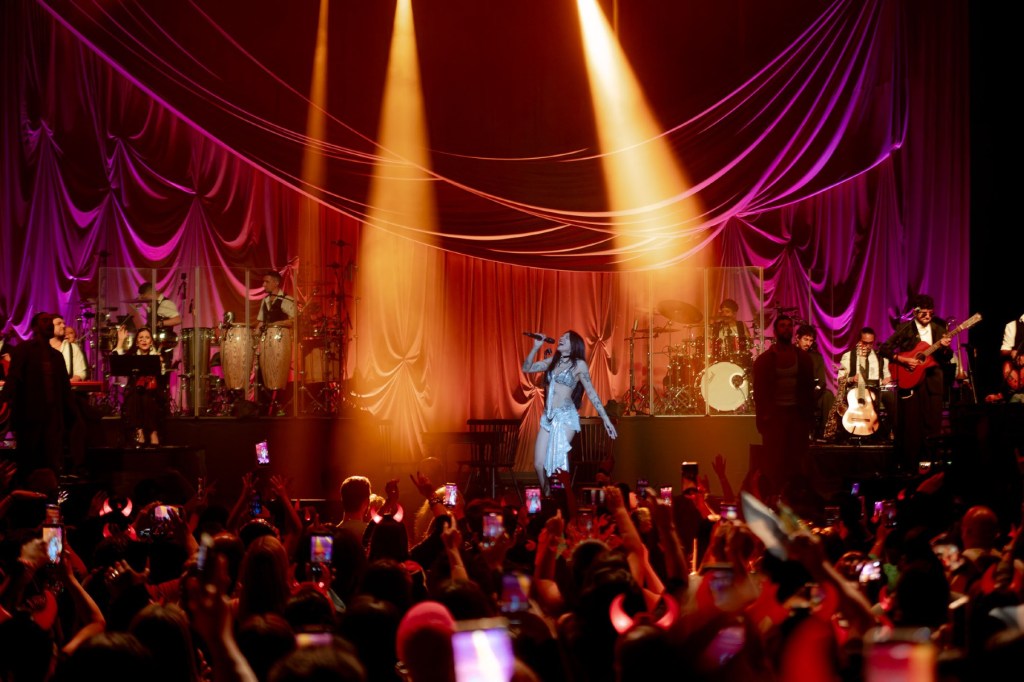
On Wednesday night, May 6, Cazzu closed out a sold-out run at the Infosys Theater at Madison Square Garden with a 2.5-hour set that felt less like a pop concert and more like an autobiographical stage play. It was the Argentine star’s first-ever U.S. tour stop, and she treated the packed house to a tense, stylish synthesis of tango, trap and dramatic staging that foregrounded both national identity and theatricality.
Cazzu at Infosys Theater at Madison Square Garden, New York, on Wednesday, May 6.
@camionthecam
The set opened where her latest record does: with the bolero-tinged “Ódiame,” a song that immediately established the evening’s aesthetic — gothic romance and wounded confidence. Fans in the darkened room lit up with glowing devil horns as she sat framed in dramatic light, then rose to deliver an expertly staged tango sequence with a male dancer. What followed was a study in contrasts: intimate heartbreak songs given operatic presentation, and trap bangers reimagined by a live band pulling from Argentine folk instrumentation.
Latinaje, the album she is currently touring behind, landed on Billboard charts when it dropped last year, debuting at No. 4 on Top Latin Pop Albums and at No. 48 on Top Latin Albums — her first time appearing on those listings. Onstage, she referenced how far she had come, remembering an earlier New York show where she performed for 30 people in a tiny venue. “Good evening, New York!” she called out mid-set, voice equal parts disbelief and gratitude. “Wow, it feels so good to say that. When would I have ever imagined myself saying, ‘Good evening, New York’? Crazy.”
“It’s incredible that there are so many of you here, in this legendary place. A place where so many important artists have stood,” she said, continuing, “I promise you I will never forget this night, and I hope you keep this show in your memories too.”
Promoted by Live Nation, Cazzu will move on to multiple Texas dates this month before concluding the U.S. leg in Hollywood, Fla. on May 21. Below are the standouts from this ambitious night at MSG.
She began with theatrical restraint and built toward physical abandon. “Ódiame” read as a modern Argentine bolero, then bloomed into a full tango; later in the show she paid explicit tribute to Astor Piazzolla, summoning the composer’s modern tangos with a formidable live ensemble that included accordion, strings and saxophone. The result was an ersatz Buenos Aires dropped into midtown Manhattan: melancholic, sensual and muscular.
For roughly the first two-thirds of the night Cazzu staged a tightly choreographed theatre piece. Shifts in set and costume accompanied a recurring cast of four men who rotated through roles — waiters, rivals, gangsters, lovers — their presence providing a visual shorthand for the album’s themes of desire, power and betrayal. Cazzu moved between coquettish and imposing with a sly, controlled theatricality; a scene where a man attempts a kiss and is rebuffed crystallized the show’s combination of danger and empowerment. At moments the staging felt operatic, in others it flirted with the kinetic, acrobatic energy of contemporary pop theater.
With Mother’s Day approaching, she softened the production. Introducing “Inti,” a tender song named after her daughter with Christian Nodal, Cazzu spoke about parenthood and the vulnerability it has forced into her writing. The speech was personal — a reminder that her career now folds into a public motherhood, and that candid songwriting has become part of her toolkit.
“Latinaje, and all of you — this whole beautiful family who have joined Team Cazzu — have taught me to overcome my own self-doubt, to be myself, and to write honest songs like the one coming up next, which I wrote with so much love for my little girl,” she said.
That moment also echoed the work she has carried offstage: Cazzu’s name has been tied to advocacy efforts in Mexico, including the Cazzu Law initiative aimed at helping single mothers navigate legal obstacles to protect their children’s mobility.
Mid-show, the mood pivoted back toward the primal energy that first built Cazzu’s fanbase. She reinterpreted material from Nena Trampa (2023) with live instrumentation that replaced programmed beats with visceral, humanized sound. In tiny black shorts and a mesh overlay she tore through verses on tracks such as the drill-leaning “Jefa” and the confrontational “Yo, Yo y Yo,” the live band lending a rougher, more immediate texture to songs that originally rode digital production.
As the production wound down, Cazzu shifted into a quieter, karaoke-style segment that foregrounded communal singing. Decked in a shimmering silver outfit, she ran through beloved covers — Selena’s cumbia “Si Una Vez” and the ranchera “No Me Queda Más” — and used a moment between songs to note a pre-show playlist she had curated, which had spanned New York salsa to regional Mexican hits.
“I heard that you all got excited with some mariachi songs,” she told the crowd. “You know that I love them. It’s the beautiful music of my beloved Mexico.” That tenderness gave way to one of the night’s most visceral reactions: the penultimate number was her Billboard-topping Argentina hit “Con Otra,” a cumbia villera that, amid industry gossip, has been rumored to take aim at Ángela Aguilar. The track became the evening’s anthem; the audience sang every line and spilled the chant onto the street when the show ended.
“It’s fun to be empowered, sensual badasses,” Cazzu said at one point, a remark that felt less like bravado and more like a thesis for an evening that continually toggled between intimacy and spectacle.
What stood out was not just the scale of the production but the way Cazzu used that scale to insist on specificity: Argentine instruments, tango references and regional Mexican nods threaded through trap and pop structures. The result was a consoling paradox — a stadium-tinged spectacle that still felt rooted in locale and personal history, a middle ground between the transnational reach of Latin pop and the rootedness of the scenes she came from.
Whether she’s reclaiming tango motifs or stomping through trap bangers, Cazzu’s MSG night read as a statement of intent. This was a debut U.S. trek stop that mapped where she’s been and suggested where she might take Latin music next: toward productions that refuse to be tidy, that fold multiple traditions into a single stage language and leave the crowd outside chanting cumbia under a Manhattan sky.