Physical Address
304 North Cardinal St.
Dorchester Center, MA 02124
Physical Address
304 North Cardinal St.
Dorchester Center, MA 02124
Kevin Powers' debut single "Move On," featuring Shaboozey, updates the city-leaves-you country trope and reached No.49 on Billboard Country Airplay.
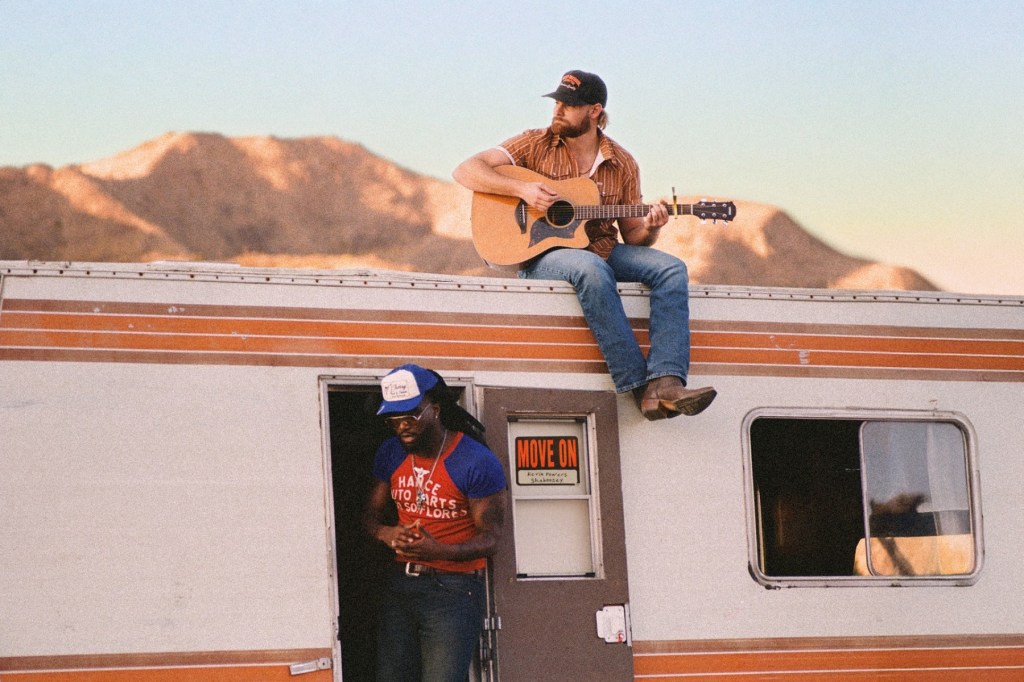
Kevin Powers’ first single, “Move On,” with a guest turn from Shaboozey, has quietly become a career-making moment: the track is bulleted at No. 49 on Billboard’s Country Airplay chart dated May 9, in its third week. The song also marks Powers’ official arrival on Shaboozey’s American Dogwood imprint after the two connected over a demo in Los Angeles.
The record wears a familiar country motif—a woman leaving for the bright lights of the coast while the guy is left behind—but it packages that storyline in a lean, folk-influenced country arrangement. Powers himself shrugs off any need for a specific geography: “I don’t think I necessarily had a specific [city] in my mind,” he says. “But I did want to kind of put my twist on that classic story of, you know, guy’s-back-home-and-girl-chases-the-big-dreams-in-the-city kind of thing.”
The song’s creation was meticulous rather than accidental. The seed was planted in June 2025 at the Nashville home of songwriter-producer Serg Sanchez, where Powers sat down with Alex Cabrera and David Ray, the latter known for cuts like “Son of a Sinner” and “Save Me.” They chased ideas for hours—”probably three hours,” Powers recalls—before the lyric “Who taught you how to move on” landed and reshaped the room.
“The title really hit me,” Ray says. “I thought it was just such a cool, relatable concept for a song. It super-inspired me from the jump.” Sanchez and Cabrera set a repeating four-chord pattern, and Powers found a descending melody that framed the chorus. Halfway through, the writers slipped in a winding top line and a different phrasing to keep that section from feeling static. “We just wanted a cool B-section for that hook to make it feel fresh and new,” Powers explains. “Anything,” Ray adds, “to keep the listener listening.”
Once that hook was in place, momentum arrived fast: the chorus came quickly and the opening verse followed “in eight minutes, maybe,” Powers says.
They broke to let the song sit. “You don’t just throw anything in the background of a Mona Lisa,” Ray suggests, insisting they take time to settle the arrangement rather than rush it.
Weeks later, Powers carried the idea west to California, arriving at the studio of writer-producer Sean Cook to write with longtime friend Whit Kane. Cook liked the hook but felt the underpinnings needed simplification—the original guitar harmony leaned oddly jazzy. Jake Torrey, who had just wrapped a separate session with Cook, dropped by and played a cleaner four-chord passage that pushed the tune toward California country-rock.
Shaboozey happened to be in the studio that day—he’d been invited by Cook to hear what they were working on. Powers turned to him and asked, essentially, what were the odds he’d jump on the track. “I walked in, heard what they had goin’ on, and it stuck with me right away,” Shaboozey says. “The more it came together, I just looked at ’em like, ‘Y’all mind if I step in on this one?’ They were all for it.”
He freestyled a second verse that deepened the narrator’s loneliness—”sleeping on a mattress as cold as you”—and did so in what Kane describes as a rapid burst. “That second verse was probably written in the span of, I’d say, 30 minutes,” Kane notes. “Maybe an hour, if you counted us going outside and getting some sun.” Shaboozey remembers looping the production and going line by line until the right words arrived: “Honestly, it all came together real naturally and that’s usually how the best records get made.”
Powers pushed for an unconventional bridge that dips lower than the rest of the melody before rising, a small moment that he calls his favorite. The lyric asks, “Who do you see when you close your eyes?”—a subtle attempt at emotional resolution. “Wasn’t too much second guessing on that song, until that bridge,” Powers admits. “I was like, ‘Is this too simple and plain?’ But they’re like, ‘No, it works.'”
They rounded the performance out with gang vocals to give the song a communal, upbeat veneer that deliberately contrasts the man’s melancholy. “The contrast of a timeless song is either you got a really sad track and somebody saying something really happy, or you got a really happy track and somebody saying something pretty depressing,” Kane says. “Even though what we’re saying is extremely sad and we’re kind of lost, we’re making really fun music about it, which can be a light for someone that’s going through that same thing.”
Cook played bass and multiple stringed instruments on the session, and the production added country staples: steel guitarist Smith Curry and fiddler Clayton Penrose-Whitmore. Drummer Ryan Cook, Sean’s brother, kept the groove spare but memorable; Powers remembers likening a couple of fills to Fleetwood Mac’s “Dreams.” “I remember being like, ‘That sounds like “Dreams,” by Fleetwood Mac,'” he says. “Sean’s like, ‘Yeah, I think that’s the point.'”
Shaboozey signed Powers to American Dogwood, and the label released “Move On” in tandem with Empire in September. Six months later, on March 31, American Dogwood officially serviced the single to country radio via PlayMPE. The song’s steady climb onto Country Airplay suggests the collaboration’s blend of classic narrative and contemporary production is connecting with programmers and listeners.
Shaboozey speaks plainly about why he invested in Powers: “He’s got an undeniable tone to him – real edge in the way he comes across sonically, something you don’t hear every day. He’s one of the most talented writers I’ve been around, no question. So when it came time to build this thing out, there wasn’t a better first artist to bring into the fold.”
“Move On” doesn’t rewrite country history, but it lands as a tidy update: mostly acoustic and brisk, indebted to tradition while leaning into a modern, West Coast-tinged production. It also positions Powers as a writer and vocalist to watch—someone who can nod to the past while engineering a debut that feels deliberate rather than rushed.