Physical Address
304 North Cardinal St.
Dorchester Center, MA 02124
Physical Address
304 North Cardinal St.
Dorchester Center, MA 02124
Lindsey Stirling and ARKAI discuss their collaboration, their Gold Gala debut and what their string-forward partnership could become next.
Two years ago, when someone suggested Lindsey Stirling should connect with ARKAI, the New York-based electroacoustic string duo, she did not need much convincing. Stirling had spent most of her career working around producers who arrived with backing tracks already mapped out and were often too hesitant to push back on her violin lines. What she rarely got was the chance to sit with other string players, people who actually spoke the same musical dialect.
“I was so excited to collaborate with someone who spoke my language,” Stirling tells Billboard of ARKAI. “We did a writing session, and afterwards, I was like, ‘That was so fun.’ My little string heart was exploding.”
ARKAI, the duo of violinist Jonathan Miron and cellist Philip Sheegog, had its own reasons for being thrilled. The pair met as students at Juilliard and have been making music together for nearly eight years. Stirling, for them, was already part of the modern string canon.
“Lindsey Stirling is an icon for the string community, because she showed us all what’s possible,” Miron says. “She showed us how we could take the old instrument, this violin, and bring it into mainstream sensibilities.”
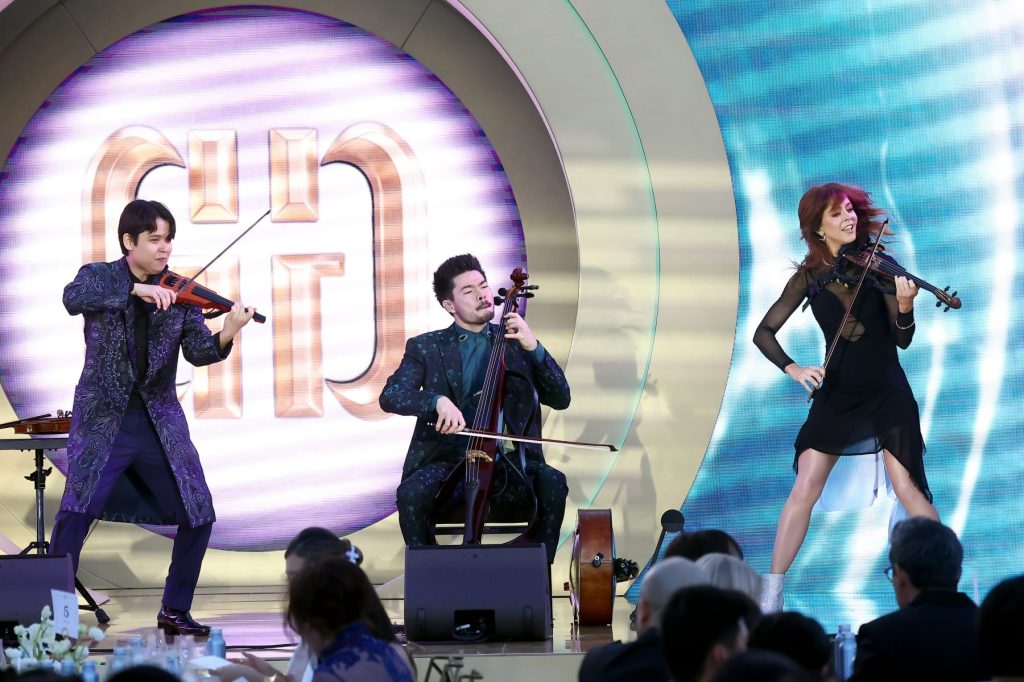
That affinity was obvious from the start, and it has only deepened. Since meeting, the three musicians have kept writing and jamming together, and last year ARKAI joined Stirling on her “Master of Tides” cruise, a multi-day music festival at sea. Their most recent outing was the Gold Gala, the annual event that gathers leaders across industries to honor Asian Pacific and multicultural trailblazers. There, Stirling and ARKAI debuted original music onstage for the first time, reworking ARKAI’s “High Noon,” from their Grammy-winning 2025 album Brightside.
Billboard spoke with Stirling, Miron and Sheegog about the performance, the chemistry that has made the collaboration click, and why this still feels like the beginning rather than the end.
The Gold Gala was not just another stop on a calendar. For Miron, the setting gave the performance an added charge.
“The Gold Gala is kind of like the Met Gala for the Asian community,” he says. “So to get invited and to be featured at an event like that was a dream come true.”
ARKAI opened with a medley of iconic Asian soundtracks before Stirling came out to join them, marking what Miron notes was their first time performing an original song with her. The crowd, he says, made the whole evening feel unreal.
“All these things coming together, we are still pinching ourselves, it was a crazy experience.” Looking out at the room, he adds, meant seeing figures like Eileen Gu and Jet Li, people the trio had long known from screens and major cultural moments. “For us to be able to share our own music with these people is really an incredible honor.”
The song they chose was “High Noon,” which lives on Brightside in one form already. But ARKAI had been thinking about a different version from the start. In the studio with Stirling in New York, they began imagining what would happen if she were folded into one of their existing pieces, rather than building something new from scratch.
“We were like, ‘Well, Lindsey would absolutely slay on “High Noon,”’” Miron says. The duo had already been considering a deluxe version of the album featuring collaborators, and the song’s melodic core seemed like the obvious place to start.
Sheegog describes the original as expansive and heavily arranged, a track built on what he calls “a massive cinematic IMAX experience.” The challenge, and the appeal, was to pull at its hooks without losing the song’s identity. “What would happen if we kind of pulled [the hooks] a little bit towards Lindsey’s aesthetic?” he says. “Make it a little bit faster, a little bit more dance pop-infused, a little more electronic-infused.”
The result, as he frames it, is a merger of their two worlds. “Hopefully when a fan listens to it, they say, ‘That’s Lindsey, but it’s also ARKAI, and it’s the two together.’”
For Stirling, the appeal of working with ARKAI has less to do with novelty than with process. “It is unlike any other process I’ve ever done,” she says. “Usually you’re working with guys that have tracks or maybe they’re playing piano. But there’s something about the reverberation of strings together that actually makes your heart swell.”
She says the sessions tend to begin loosely, without a fixed tempo, with the three of them simply playing off one another. The group records everything, then returns later to isolate the best bits and turn them into more finished melodies. That give-and-take is part of what keeps her coming back.
“It’s so fun to write with them. I would do it any chance I get,” Stirling says.
Sheegog says the dynamic works because ARKAI already operates as a tightly self-contained unit. “For the last almost eight years, we’ve been a duo, we basically have only written with each other,” he says. “We write, arrange and produce all of our own music, so we know each other inside and out at this point.” Stirling, though, adds a different pressure in the best sense. She understands the language of strings, but her phrasing and instincts are her own. “Throwing that new element into the creative mix that we’ve been working in for years at this point, I think that was really, really fun, because it keeps you on your toes.”
That sense of momentum is already extending beyond “High Noon.” Stirling says the trio plans to do more together, including select U.S. tour dates this summer, and that they have also worked on material for her next album, which she hopes to release next year.
“I would love to have their voices on it,” she says. “I’m excited to not only have ‘High Noon’ to release this year, but also, next year, another track.”
Part of the broader significance here is how plainly all three talk about visibility and possibility. Stirling remembers growing up with very few options for what a string player could be. “It was classical music and maybe fiddle music, and there wasn’t really any other option,” she says. “I remember I never wanted to perform at the talent show, because I was like, ‘Everyone will be bored.’”
That is why, for her, the point is not only to widen the frame for string players, but to offer a version of creativity that feels less boxed in overall. “I would love for kiddos to feel like they could play something that maybe feels a little bit more contemporary, and they can be cool,” she says. She also wants the example to travel beyond music: “I hope that by being authentic and outside of the box, that people realize that whatever they do, they can reinvent themselves, they can step outside the lines.”
Miron echoes that idea from a different angle, crediting Stirling as the kind of artist who helped make his own path seem possible. “If Lindsey can do it, maybe we can do it as well,” he says, describing her influence as something that reaches beyond one genre or instrument. In his view, the stakes of thinking differently only grow as the industry and the broader culture lean harder on automation and AI. “We’re going to need new ideas,” he says. “We’re going to need people doing different things, and that’s how you stand out.”
Sheegog points to the name ARKAI itself, which comes from a Greek word meaning “leaders.” It was aspirational from the beginning, but he says he and Miron now see themselves as part of a much longer chain, one that runs back through Stirling and her peers and even further to earlier pioneers. The hope is that somebody younger will eventually look at them and feel the same opening they once felt.
“Because I saw what you were doing, I had the courage to write,” he says, imagining the kind of line he wants to hear one day. “It’s so much more than music.”
Their Grammy win, the first for ARKAI, only sharpens that sense of movement. Sheegog is blunt about what an award like that can do in rooms that might otherwise stay closed. “To the haters who are going to hate, hopefully, it just shuts some of them up,” he says. More importantly, he sees it as a kind of permission slip for listeners who may not know where to place them yet. “You’re outside the box, but you’ve got this stamp of approval, so we’ll listen to you.”
Miron, speaking after the win, framed it in more personal terms. For people who have been rejected or shut out, he said, the moment could stand as proof that risk sometimes pays off. “Philip and I are indie musicians, we’ve built everything pretty much from the ground up. Lindsey is the same,” he says. “If you have a vision for something, a passion for doing something, if you put your heart into it, you can achieve anything.”
Stirling, for her part, is in a reflective place of her own. She says she has been writing a lot lately, which is notable given how hard writing has historically been for her. “I’ve always really struggled with self negativity,” she says, adding that this is the first time she feels she is not fighting herself through the process. Maybe it is therapy, she suggests, or meditation, or something less easy to pin down.
“I’m so happy right now, just in general,” she says. “I don’t even have the fruits of the labor yet, I can’t even see if anyone likes anything I’ve written. But it doesn’t matter. I’m really just happy and I’m enjoying the journey, not just the destination.”
That is where this collaboration lands most clearly: not as a one-off crossover, but as a working relationship built on mutual recognition, shared discipline and a sense that the next few steps could matter as much as the first. For Stirling and ARKAI, that seems to be the point.